Building an AI Governance Framework That Fits a Small Business
The need for clear AI governance for small businesses is more pressing than ever. Searches for “AI governance framework” have nearly doubled since January 2024, a clear sign that teams are struggling to operationalize GenAI safely. As Red Hat’s 2024–25 research on deployment pain points highlights, technical hurdles are often compounded by a lack of clear strategy and oversight.
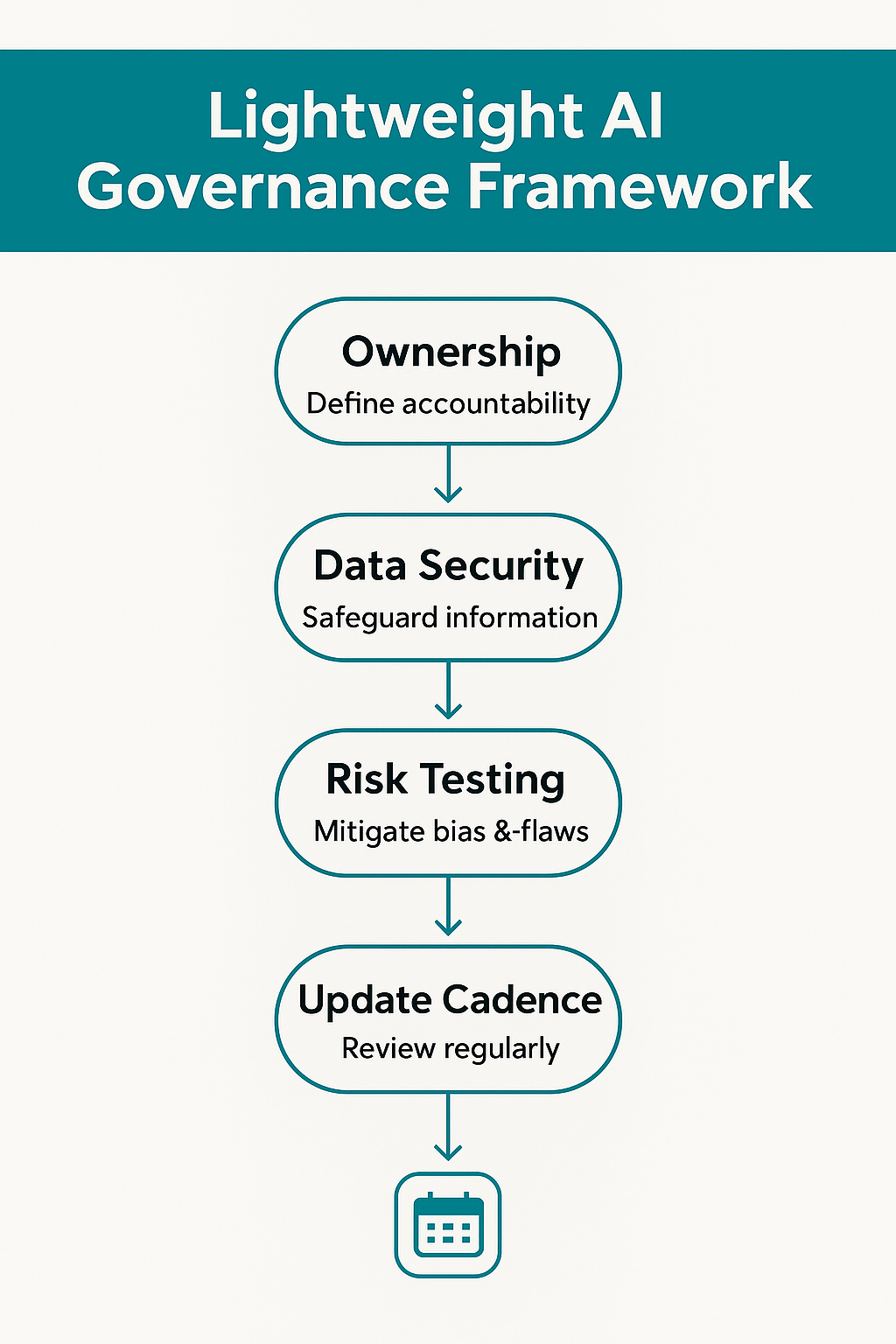
1. Ownership: Who's in Charge of Your AI?
Prompt Guidelines: Establish clear guidelines for how employees should interact with AI, especially when inputting sensitive data or generating public-facing content. Who approves the core “prompts” or instructions that guide your AI tools, especially for critical tasks?
Model Update Review: AI models are constantly evolving. Determine who reviews and approves these updates. Are there specific performance benchmarks or safety checks that must be met before a new model version is deployed?
Escalation Path: What happens if an AI output is questionable, biased, or even unsafe? Define a clear escalation path. Who should be notified? What’s the process for investigation and correction? This turns a potential crisis into a manageable incident.
2. Data Security: Protecting Your Information from End to End
Input Data Protection: What kind of data can be fed into AI models? Establish strict rules about sensitive customer information, proprietary business data, or confidential communications. Ensure your AI tools comply with your existing data privacy regulations (like GDPR or CCPA) and internal policies.
Output Data Handling: How will AI-generated content be handled? Is it stored securely? Who has access to it? What are the retention policies?
Third-Party AI Tool Vetting: Before adopting any new AI software, conduct thorough due diligence. What are their data privacy and security policies? Where is your data stored? How is it used? A one-page privacy checklist can simplify this vetting process, ensuring you ask the right questions every time.
Access Controls: Implement strong access controls for anyone using or managing AI tools. Not everyone in your company needs access to every AI system or its underlying data.
3. Risk Testing: Spotting and Mitigating Bias and Flaws
Bias Checks: How will you test for bias in your AI outputs? For example, if you’re using AI for hiring, how do you ensure it’s not discriminating based on gender, age, or ethnicity? Simple, repeatable tests should be documented.
Performance Monitoring: Beyond bias, how do you ensure the AI is performing as expected? Set up metrics to track accuracy, relevance, and efficiency.
Human-in-the-Loop Review: Not every AI output should go straight to a customer or into a business decision. Define when human review is mandatory. This “human-in-the-loop” approach adds a vital layer of quality control and ethical oversight. For instance, any customer-facing communication generated by AI might require human approval before being sent.
Auditing and Logging: Ensure your AI systems log their activities, inputs, and outputs. This creates an audit trail that can be invaluable for troubleshooting, compliance, and demonstrating accountability.
4. Update Cadence: Keeping Your Playbook Fresh
Quarterly Review: Schedule a regular, ideally quarterly, review of your AI governance playbook. This ensures it remains relevant and addresses new challenges or opportunities.
Feedback Loop: Encourage employees using AI tools to provide feedback on the playbook. Are there areas that are unclear? Are new risks emerging?
Stay Informed: Dedicate someone (or a small team) to staying informed about new AI regulations, best practices, and emerging risks. This doesn’t have to be a full-time job; a few hours a month can make a big difference.
Cost Tracking: Integrate a cost tracker into your AI usage. Finance needs to see usage and expenditure in near real-time. This helps control budgets and informs future AI investments.
Your One-Page AI Governance Checklist
Moving from broad guidelines to a practical playbook is about transforming compliance from a blocker into a documented, low-friction routine. By defining who approves prompts, how bias tests run, what the escalation path is, and when human review is mandatory, you create clarity and confidence. Store this playbook in your company’s existing knowledge base, your intranet, shared drive, or preferred collaboration tool, so it’s easily accessible to everyone.
To get started, download our one-page AI governance checklist. It’s designed to help small businesses quickly assess their current state and identify immediate next steps for building a robust, yet flexible, AI governance framework that scales with their ambition.
Ready to Build Your Lightweight AI Playbook with Braveheart?
Our experts work with you to develop and implement a customized, lightweight AI policy and playbook that fits your unique needs. We guide you through defining ownership, establishing strong data security protocols, setting up practical AI risk management processes, and creating an effective update cadence. We don’t just provide theoretical advice; we deliver the actionable strategies and tools, including your personalized one-page governance checklist, to ensure your AI initiatives are both innovative and secure.
Take the next step:
Download our detailed One-Page AI Governance Checklist to get started on your own.
Contact Braveheart today for a free consultation to discuss how we can help you build your tailored AI governance playbook.