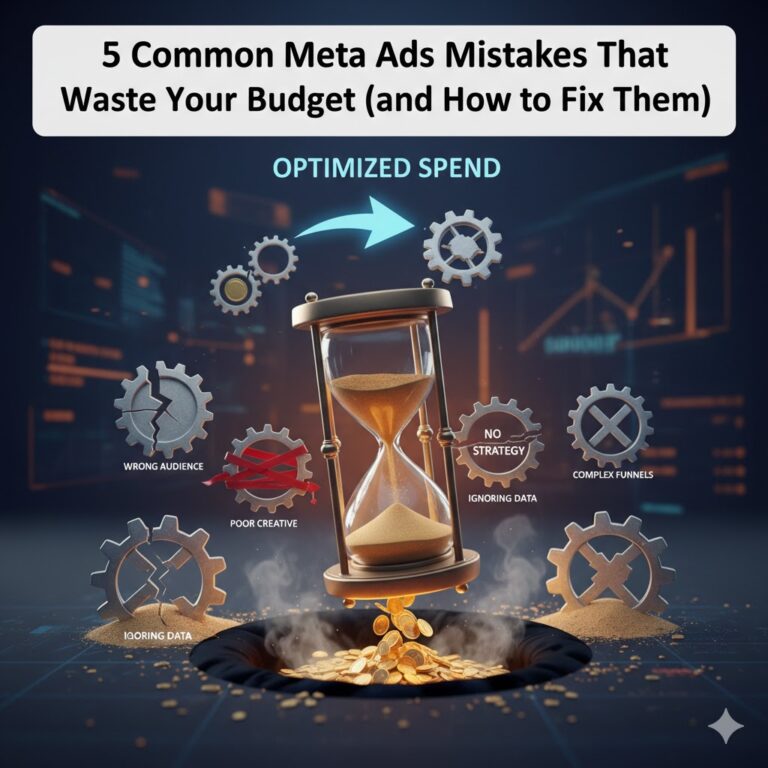
The Most Costly Facebook Ads Mistakes (and How to Fix Each One)

You’ve set up the campaign. You’ve written the copy. You’ve hit publish. And then you wait.

The budget spends. The impressions roll in. But the leads don’t come, or the cost per result is three times what it should be, and you’re not sure why.

Most Facebook advertising mistakes aren’t obvious while you’re making them. They look like reasonable decisions. That’s what makes them expensive. This post covers the six most common ones we see when auditing ad accounts, including a new category that’s emerged with the rise of AI-generated creative..

Mistake 1: Using Broad Targeting and Calling It Advantage+

Meta’s Advantage+ audience settings have made it easier than ever to launch a campaign without defining a real target audience. The platform’s pitch is compelling: let the algorithm find your buyers. For some campaigns, at sufficient scale, that works. For most small and mid-size advertisers, it’s a budget drain.
The problem isn’t that Meta’s AI is bad at finding audiences. The problem is that ‘finding an audience’ and ‘finding buyers’ are different tasks, and Advantage+ optimizes for the former unless you give it strong conversion signal data to work from.
Common meta mistakes

What to do instead: If your pixel has fewer than 500 conversion events in the last 30 days, don’t rely on broad Advantage+ targeting. Use defined interest or lookalike audiences while you build your conversion history. Switch to broader Advantage+ targeting only once the algorithm has enough purchase or lead data to work with.

Advantage+ targeting requires strong conversion signal data to find real buyers, not just people who click.

Mistake 2: Letting Advantage+ Creative Override Your Brand

Advantage+ Creative is a separate tool from Advantage+ audiences, and it’s one that advertisers accept without fully reading the fine print. When you turn it on, Meta is authorized to modify your creative: adjusting brightness and contrast, adding music, generating alternative text, and in some cases changing the aspect ratio of your images.
For brand-conscious advertisers, this is a real problem. The ad that shows to your audience may look significantly different from the one you created. We’ve seen cases where Meta’s AI modifications changed a clean, professional brand ad into something that looked like stock footage.

What to do instead: Go into each ad’s creative settings and review which Advantage+ Creative enhancements are toggled on. Turn off music overlays, image enhancements, and text optimizations unless you have explicitly tested and approved the outputs. Keep 3D animation and visual touch-ups off by default for brand campaigns.

Mistake 3: Killing Campaigns During the Learning Phase

Meta’s ad delivery system requires a learning phase to optimize. The threshold is typically 50 optimization events per ad set within a 7-day period. During this phase, performance is deliberately unstable — the algorithm is testing delivery patterns, audience segments, and timing.
The most common mistake is making changes or turning off campaigns during this window. An advertiser sees a high cost per result in days two or three, concludes the campaign isn’t working, and pauses it. They’ve just interrupted the learning phase and will start from scratch if they relaunch.

What to do instead: Give a new campaign at minimum seven days and 50 conversion events before drawing any conclusions. If you can’t reach 50 events, optimize for a higher-funnel event (landing page views instead of purchases, for example) to get through the learning phase faster. Only evaluate true performance once the ad set status shows ‘Active’ rather than ‘Learning.’

One of the most reliable ways to waste a Facebook ads budget: judge performance before the algorithm has finished learning.

Mistake 4: Optimizing for the Wrong Conversion Event

The conversion event you select at the campaign level tells Meta what you want to achieve. Choose ‘link clicks’ and Meta will find people likely to click links. Choose ‘purchase’ and it will find people likely to buy. These are different people, and optimizing for one when you want the other is one of the most costly mismatches in ad setup.
We regularly see advertisers optimizing for reach or link clicks because their pixel doesn’t have enough purchase data yet — then wondering why their cost per sale is high. The campaign is doing exactly what it was told to do.

What to do instead: Map your optimization event to your actual business goal, then work backwards to ensure you have enough data. If you don’t have 50 purchases per month, optimize for ‘add to cart’ or ‘initiate checkout.’ If you’re running lead gen, ‘complete registration’ beats ‘link click’ by a significant margin once you have the pixel data to support it.

Mistake 5: Missing Creative Fatigue Until It's Too Late

Creative fatigue happens when your audience has seen the same ad enough times that engagement drops and your CPM rises. It’s gradual, which is why it often goes unnoticed until the account has been bleeding budget for weeks.
The metric to watch is frequency. When frequency climbs above 2.5 on a cold audience campaign, you’re paying more to reach people who’ve already seen your ad and aren’t converting. When CTR starts dropping alongside a frequency increase, that’s the signal that your creative has worn out.

What to do instead: Set a frequency cap or schedule creative refreshes proactively. For evergreen campaigns, plan a new creative set every four to six weeks. For promotional campaigns, monitor frequency daily and swap creative when it exceeds 3.0. Build a creative pipeline so you’re never scrambling.

Mistake 6: AI-Generated Ad Creative Errors

This is the newest entry on the list, and it’s becoming one of the most common issues we see in 2025 and 2026 accounts. As more advertisers use AI tools to generate ad images, copy, and video, a new category of mistakes has emerged.

Wrong aspect ratios: AI image generators default to standard dimensions that don’t always match Meta’s placement specs. An image generated at 1:1 that Meta then crops for a 9:16 Story placement will lose critical visual information. Always check: Facebook Feed (1.91:1 or 1:1), Instagram Feed (1:1 or 4:5), Stories and Reels (9:16).

Brand inconsistency: AI tools generating creative without a brand style guide produce visuals that may be technically competent but visually off-brand. Colors drift, fonts change, the tone shifts. Over time, your ad account starts to look like it belongs to four different companies. Feed your AI tools explicit brand parameters before generating any creative intended for paid distribution.

Policy violations in AI copy: AI-generated ad copy has a habit of producing claims that violate Meta’s advertising policies: implied guarantees, before-and-after framing for certain product categories, exaggerated income claims, and in the health and wellness space, therapeutic claims. Review every line of AI-generated copy against Meta’s ad policies before publishing. A policy violation doesn’t just reject the ad — repeated violations can restrict the account.

Hook mismatch: AI tools optimize for engagement signals in their training data, which often means generating scroll-stopping hooks that are high-sensation but low-relevance to your specific offer. A hook that triggers curiosity but doesn’t connect to what you’re selling produces clicks without conversions. Write your hooks with your specific audience and offer in mind, even if you’re using AI to generate variations.

The Pattern Behind All Six Mistakes

Every mistake on this list has the same root: a decision that looks reasonable in isolation but ignores how Meta’s delivery system actually works. The platform rewards advertisers who understand the algorithm, give it the right inputs, and have the patience to let it optimize. The ones who cut campaigns early, optimize for the wrong event, or let AI tools run without guardrails pay a premium for that friction.
If your Meta campaigns aren’t performing the way they should, it’s worth doing a systematic audit of each of these areas before increasing budget. More spend on a broken campaign structure doesn’t fix the campaign.

Frequently Asked Questions

What are the most common Facebook ad mistakes?
The most common are: targeting too broadly without conversion data, letting Advantage+ Creative modify brand assets unchecked, pausing campaigns during the learning phase, optimizing for the wrong conversion event, ignoring creative fatigue, and publishing AI-generated creative without policy review. Each of these is fixable once you know what to look for.

Why are my Facebook ads not performing?
The most likely causes are either a campaign structure problem (wrong objective, insufficient conversion data, audience too broad or too narrow) or a creative problem (fatigue, policy violations, or mismatch between the hook and the offer). Start by checking your frequency rate and your optimization event before assuming the audience is the issue.

How long should I run a Facebook ad before judging it?
At minimum, allow seven days and 50 optimization events before drawing conclusions. Meta’s learning phase requires this volume of data to stabilize delivery. Evaluating performance in the first three days almost always leads to premature decisions

Contact us today for a free Meta Ads account audit and discover how to make your advertising budget work harder for you.

Recent Posts

Answer Engine Optimization

Answer Engine Optimization

Answer Engine Optimization (AEO): How to Earn Visibility in the Age of AI Answers https://www.youtube.com/watch?v=deOL5KUtkjc As AI-driven platforms like Google’s Search Generative Experience (SGE), OpenAI’s ChatGPT, Perplexity,

Read More »