Scaling AI Use Cases

scaling ai use cases

Scaling AI Use Cases: Playbook for Business Growth

You’ve successfully piloted an AI solution, measured its ROI, and perhaps even operationalized it. That’s a huge win! However, as IBM wisely observes, pilots are fun, but scaling is where real value is created. Many businesses stop at isolated experiments, missing out on the exponential benefits that come from systematically expanding AI’s footprint across their organization.

Moving beyond a single, successful use case to a broader enterprise-wide AI rollout can seem daunting for a small business. But with a strategic playbook, you can effectively expand AI adoption, ensuring your initial successes are just the beginning. This isn’t about launching a hundred pilots; it’s about replicating proven patterns, integrating AI deeply into your workflows, and fostering an internal culture of continuous AI-driven innovation.
The concept of scaling AI use cases is trending upward, fueled by mid-market success stories in diverse sectors like media and retail. This demonstrates that impactful AI expansion isn’t exclusive to tech giants. By understanding how to strategically grow your AI capabilities, your business can truly differentiate itself and unlock competitive advantage.
So, how do you take one success and systematically replicate, integrate, and transform your business with AI? Let’s explore a three-stage AI maturity model for scaling.
scaling ai use cases

The AI Maturity Ladder: Replicate, Integrate, Transform

Your journey beyond the pilot involves a deliberate climb up this ladder, each stage building on the last.

Stage 1: Replicate – Reuse, Refine, and Reapply

With one solid success in production, it’s time to leverage what you’ve learned.

Open Your Use-Case Backlog: Go back to the backlog of potential AI use cases you likely created during your initial Discovery phase. Now, prioritize two or three more high-value use cases that share similar characteristics or data needs as your successful pilot. Reference valuable resources like OpenAI’s 2025 checklist on identifying and prioritizing new use cases for structured guidance.

Rapid Readiness Checks: Because you’ve been through the process once, you can execute readiness checks (data availability, stakeholder buy-in, KPI definition) much more quickly. Your team already understands the drill.

Reuse Training Assets: Don’t reinvent the wheel. The training materials, prompt templates, and internal knowledge you built for your first pilot can be reused and quickly adapted for these new use cases, saving significant time and resources.

Iterate on Feedback: Apply lessons learned from your first pilot’s operationalization and measurement phases. What worked well? What could be smoother? This continuous feedback loop accelerates replication.

Stage 2: Integrate – Connecting Systems End-to-EndAdd Your Heading Text Here

This stage moves beyond isolated AI tools to connecting them deeply with your core business systems and processes.

Beyond the “Sandbox”: While initial pilots might use AI as a standalone tool, integration means connecting it directly to your CRM, ERP, marketing automation platforms, or internal databases.

Automate Workflows: Look for opportunities to automate entire workflow segments where AI can seamlessly hand off tasks to other systems or trigger subsequent actions. For example, AI-qualified leads directly pushed into your sales CRM, or AI-generated reports automatically distributed to stakeholders.

Data Flow Optimization: Ensure smooth, secure, and automated data flow between your AI models and your existing enterprise data infrastructure. This is critical for reliable, high-volume AI operations.

Stage 3: Transform – Building an AI Center of Excellence

This is the ultimate goal of scaling AI use cases: establishing an internal capability that fosters long-term AI innovation and adoption. Your role as an external advisor will gradually shift from a hands-on builder to a strategic guide.

Form an Internal AI Center of Excellence (CoE): This doesn’t have to be a large, dedicated department. For an SMB, it might be a cross-functional group of passionate internal champions, perhaps the “AI champions” you trained earlier. Their role is to own experimentation, evaluate new AI technologies, and manage change.

Establish a Monthly “AI Council” Meeting: This is a crucial change-management tactic. Gather cross-functional leaders from different departments to share wins, discuss new opportunities, raise risks, and collectively keep the AI momentum alive. This ensures alignment and broad buy-in.

Keeping the Momentum Alive: Essential Change Management Tactics

Successful enterprise-wide AI rollout is as much about people and culture as it is about technology.

Internal Newsletter of Wins: Celebrate every AI success, big or small. An internal newsletter or dedicated communication channel highlighting how AI is saving time, increasing revenue, or improving employee experience builds enthusiasm and showcases tangible benefits.

Budget Line for Continuous Training: AI evolves rapidly. Dedicate a consistent budget for ongoing AI upskilling and specialized training to ensure your team’s skills remain sharp and they can leverage new AI capabilities as they emerge.

Executive Sponsorship: Ensure leadership remains visibly committed to AI initiatives. Their support is vital for overcoming resistance and driving adoption.

By systematically following this maturity ladder and integrating robust change management, you won’t just have an isolated AI pilot; you’ll have an AI center of excellence driving continuous innovation and value across your entire business.

Braveheart: Your Partner in Scaling AI Across Your Enterprise

Moving beyond pilot success to a full enterprise-wide AI rollout can be complex, requiring expertise in strategic planning, technical integration, and organizational change management. At Braveheart, we specialize in helping small and mid-sized businesses expand AI adoption effectively and sustainably.

We guide you through replicating proven patterns, seamlessly integrating AI into your core systems, and establishing an internal AI center of excellence that empowers your team for long-term success. Our structured approach, drawing on best practices and tools like our “Use-Case Backlog Template,” ensures your AI investments truly transform your business, delivering sustained value. Don’t let your AI potential be limited to a single project.

Ready to transform your business by scaling AI use cases?

Contact Braveheart today for a free consultation to discuss how we can help you build your internal AI capabilities and drive widespread adoption.

The Braveheart AI Transformation Series

Answer Engine Optimization

Answer Engine Optimization

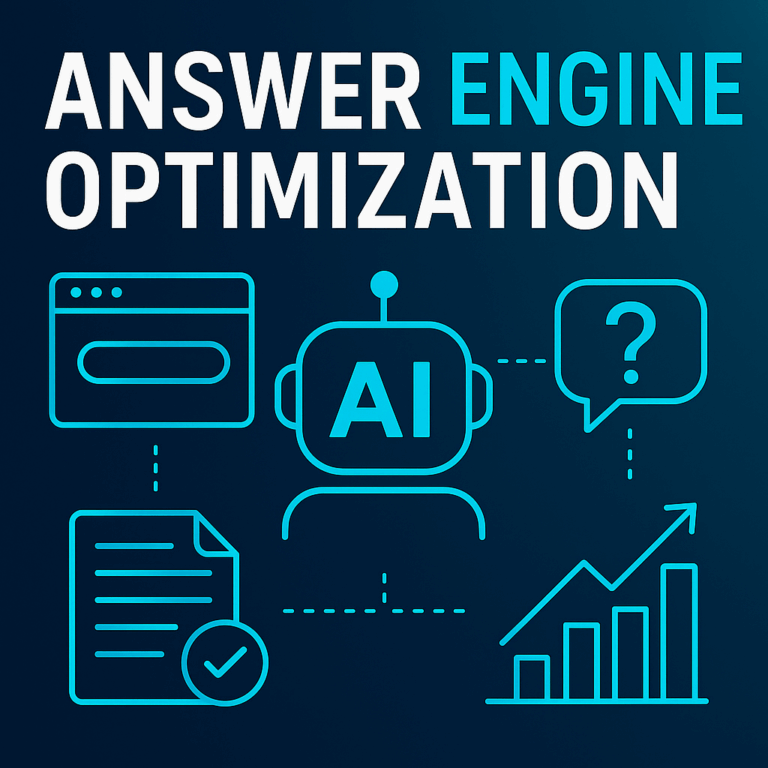
Answer Engine Optimization (AEO): How to Earn Visibility in the Age of AI Answers

As AI-driven platforms like Google’s Search Generative Experience (SGE), OpenAI’s ChatGPT, Perplexity, and countless others become central to how users access information, search behavior is evolving fast. Increasingly, audiences aren’t scrolling through blue links—they’re receiving direct, synthesized responses from conversational agents. In fact, recent industry estimates suggest that four in ten Google searches now present an AI-generated answer before showing any organic result, and in some cases, they eliminate the traditional results page altogether.

This shift is more than a technological curiosity, it’s a fundamental change to how visibility works in digital search. While traditional SEO is about ranking pages in response to keyword searches, and Generative Engine Optimization (GEO) focuses on feeding content to large language models for verbatim citations, Answer Engine Optimization (AEO) addresses a new frontier: influencing how, and how often, your brand is mentioned inside the AI-generated responses users now rely on.

In plain english, Answer Engine Optimization is about being found. Generative Engine Optimization is about being understood.
Answer Engine Optimization

Why Answer Engine Optimization Demands Your Attention

For brands that depend on organic discovery, the implications of AEO are immediate and far-reaching. As Business Insider reports, a new category of analytics tools and marketing strategies is emerging around “answer share”, a measure of how frequently your brand appears in generative responses. Forward-thinking companies are already investing in AEO to ensure their expertise is surfaced, even in zero-click environments.
Early adopters are seeing the payoff. Brands that earn consistent citations in AI answers report increases in branded search volume, direct traffic, and assisted conversions. The lesson is clear: even when users don’t click, being the name the bot mentions keeps your brand in the buyer’s journey.

How AEO Differs from SEO and GEO

It’s important to understand how AEO complements, but differs from, adjacent disciplines:

SEO still plays a vital role in ensuring your content is indexed and ranked by search engines when users click through to explore.

GEO focuses on optimizing snippets and passages so that large language models like ChatGPT cite them directly, often using your wording verbatim.
Answer Engine Optimization goes further. t aims to structure content so that AI systems, regardless of interface, quote, paraphrase, or synthesize your insights as part of their own responses. The focus is on completeness, clarity, authority, and semantic structure.
While these disciplines overlap, AEO has its own tactics, tools, and key performance indicators. Its core metric is answer share: the percentage of relevant generative answers that reference your brand or its content.

The Foundations of a High-Impact AEO Strategy

Braveheart’s approach to AEO starts with a strategic rethinking of content creation and optimization, from mapping user questions to delivering schema-embedded, citation-ready answers.

Map questions, not just keywords. We begin by identifying the real, conversational questions your audience asks at each stage of the funnel, from “How much does [service] cost?” to “Is [platform] secure for regulated industries?” AI platforms and community-driven sources like Reddit, Quora, and Google’s People Also Ask provide invaluable question datasets.

Craft answer-first content. The structure of your content matters. Every key page should begin with a clear, direct answer in the first 50–75 words, optimized for citation. Follow that with detailed context. Use subheadings phrased as questions to help AI engines extract structured insights more efficiently.

Support claims with robust evidence. Large language models favor passages that cite data, link to reputable sources, and include verifiable facts. That means embedding primary data, quoting recognized experts, and using schema markup to reinforce context. Proprietary research and unique insights carry particular weight.

Use structured data to your advantage. Schema types like FAQPage, HowTo, and Speakable allow engines to easily locate and trust your answers. They help assign meaning to specific facts, such as pricing, specifications, and definitions, boosting your credibility in the eyes of AI.

Test and iterate across AI interfaces. Since generative answers are non-static, weekly testing across platforms like ChatGPT, Gemini, and Perplexity is critical. Braveheart continuously prompts these engines with your core questions to analyze which of your passages are cited, and where competitors might be gaining ground. We update, refine, and re-deploy your content accordingly.

Braveheart’s Answer Engine Optimization Methodology

At Braveheart Digital Marketing, we don’t just optimize content, we engineer an entire Answer Graph designed to secure conversational visibility across AI platforms.
Our process starts by mapping the real questions your customers ask throughout their journey, from early curiosity to final decision, so we can create content that earns visibility in AI-generated answers. Each question node is linked to an owned piece of answer-first content, embedded with schema, enriched with data, and aligned to user intent. Then, we implement a multi-pronged approach:
We run conversational audits to benchmark your brand’s current answer share across major AI interfaces.
We optimize and refresh content weekly based on where your answers fall short or where co-citations give an edge to competitors.
We integrate AEO learnings into GEO workflows, ensuring validated passages are reused in LLM-friendly formats.
We track real-world impact by linking answer share increases to growth in direct traffic, branded search, and assisted conversions.
The result? Compound visibility. Your brand not only earns citations like “According to [Brand]…” within the AI-generated response but also captures the click from users seeking deeper insight.

Ready to Be the Name AI Mentions?

If your goal is to ensure your brand is the voice users hear when they ask their next question aloud, or type it into a chatbot, Answer Engine Optimization is your next frontier. Braveheart Digital Marketing is ready to build your custom Answer Graph and turn conversational visibility into measurable business growth.

Let’s talk visibility—no clicks required.

Further Reading

Recent Posts

What is geofencing?

What Is Geofencing?

What is Geofencing? Geofencing marketing is location-based ads where a user’s location is recorded via the internet, and advertisements are only shown to people in

Read More »
Local SEO 2026

Local SEO Playbook

The 2026 Local SEO Playbook for SMBs For small and medium-sized businesses (SMBs), being visible in local search results has always been essential to attracting

Read More »
SEO in 2026

SEO in 2026

SEO in 2026 – The 5 SEO Questions Every Business Owner Is Asking If you are still doing SEO the way you did in 2023,

Read More »

AI Operationalization

AI Operationalization

AI Operationalization: Pilot to Production for SMBs

You’ve run a successful AI pilot, measured its impact, and the results are in: it’s a go! The pilot proved its value, cutting report creation time or speeding up customer service responses. But transitioning from a controlled experiment to a stable, everyday business function is where many AI projects falter. As Red Hat’s insights frequently highlight, deployment and monitoring, not just model building, are often the top sources of AI project failure.
The journey from a promising pilot to full-blown production requires careful planning, robust tools, and a shift in mindset. This is where AI operationalization comes into play. For small businesses with lean IT teams, the idea of “MLOps” (Machine Learning Operations) might sound like something only large enterprises can tackle. However, with the right strategy and tooling choices, you can achieve predictable spend and minimal consultant involvement, turning your AI into a reliable, “always-on” service.
Searches for “AI operationalization” have climbed more than 70 percent in the past year, indicating a growing recognition of this crucial phase. Yet, few small-business blogs effectively address this need, making a comprehensive guide invaluable for winning featured snippets and attracting decision-makers seeking AI deployment best practices.
So, how do you successfully move your AI pilot into a production workflow, ensuring its continued performance, cost-efficiency, and reliability?
AI Operationalization

The AI Operationalization Playbook: From Pilot to Production

Once your pilot is green-lit, it’s time to build the infrastructure and processes for sustained success.

The Hand-Off: From Data Science to MLOps (Simplified for SMBs)

In larger organizations, data scientists hand off models to dedicated MLOps engineers. For a small business, this often means your internal IT champion or a designated technical lead takes ownership.

Version Control is Key: Just like software, your AI models and their configurations need version control. Ensure any custom code, prompt templates, or model settings are stored in a version-controlled system (e.g., Git). This allows for rollbacks if issues arise and ensures reproducibility.

Documentation: Update your company’s Standard Operating Procedure (SOP) library with the new AI-powered process. Document inputs, expected outputs, user interactions, and troubleshooting steps. This ensures continuity, even if personnel change.

Named Internal Product Manager: Transfer clear ownership of the AI-driven use case to a named internal product manager or process owner. This person is responsible for the ongoing health, performance, and user adoption of the AI solution.

Automated Monitoring & Alerts: Staying Ahead of Drift and Spikes

A production AI model isn’t static. It needs continuous vigilance.

AI Model Monitoring: Implement automated monitoring for your AI solution. This isn’t just about whether the system is “up”; it’s about whether it’s performing as expected.

  • Accuracy Drift: Models can “drift” over time as real-world data changes. Monitor key performance metrics (e.g., accuracy, response quality) against a baseline. Set up alerts if performance drops below an acceptable threshold.
  • Cost Spikes: AI services, especially those leveraging large language models (LLMs), can incur costs based on usage (e.g., tokens, API calls). Set up automated alerts for unexpected cost spikes to prevent budget overruns.
  • Latency/Uptime: Monitor the responsiveness and availability of the AI service. Is it consistently delivering answers quickly?

Rollback Plans: Crucially, have a rollback plan. If an alert triggers a critical issue (e.g., significant accuracy drop, major cost spike), know how to quickly revert to a previous, stable version of the model or disable the AI function temporarily.

Tooling Choices for a Lean IT Team

You don’t need a complex MLOps platform to achieve production-grade AI. Focus on lightweight, managed services.

Managed LLM Endpoints: Instead of hosting and managing complex LLMs yourself, leverage managed services from cloud providers (e.g., Azure OpenAI Service, Google Cloud Vertex AI, AWS Bedrock). These services handle the infrastructure, scaling, and many MLOps complexities for you.

Vector Database Plug-ins: If your AI solution uses Retrieval Augmented Generation (RAG), choose vector databases or plug-ins that are easy to integrate and manage without extensive database administration.

Simple Usage Dashboards: Utilize built-in dashboards from your AI service providers or simple, customizable reporting tools to visualize usage, costs, and key performance indicators. Avoid overly complex AI KPI dashboard solutions initially.

Post-Launch Health Check & Continuous Improvement

Operationalization is an ongoing journey, not a destination.

Thirty-Day Health Check: Schedule a comprehensive post-launch health check around 30 days after moving to production. Review performance against original pilot KPIs, gather user feedback, identify new pain points, and assess resource consumption.

Update the Governance Playbook: Incorporate lessons learned from the pilot and operationalization into your overarching AI governance playbook. What new best practices emerged? What risks need to be added? This keeps your lightweight AI policy a living document.

Archive Outdated Prompt Templates: Ensure that only the most effective and approved prompt templates are accessible to users, archiving any outdated or experimental versions. This is part of maintaining version control for the actual interaction with the model.

The ultimate goal of AI production support is to have an AI use case that runs reliably with minimal human intervention and predictable spend, truly becoming an integrated, valuable part of your business.

Seamless AI Operationalization with Braveheart

Moving a successful AI pilot into production is where the real value is realized—but it’s also where many businesses falter due to a lack of specialized MLOps for small business expertise. At Braveheart, we bridge this gap, helping you confidently transition from proof-of-concept to a reliable, revenue-generating AI service.

We guide you through establishing effective AI model monitoring, implementing AI deployment best practices tailored for lean teams, and setting up critical cost alerts. Our approach ensures seamless hand-offs, robust version control, and clear ownership, so your AI solutions run with predictable spend and minimal consultant involvement. With Braveheart as your partner, you’ll have a trusted expert helping you write your “Model Service-Level Objective” and ensure continuous AI production support.

Don’t let your valuable AI pilots become shelfware. Let Braveheart help you operationalize your AI for lasting impact and competitive advantage.

Ready to turn your AI pilot into a reliable production asset?

Contact Braveheart today for a free consultation and let’s discuss how we can ensure your AI keeps the lights on.

The Braveheart AI Transformation Series

AI ROI Measurement

AI ROI Measurement

AI ROI Measurement

You’ve launched an AI pilot, your team is getting familiar with the tools, and you’re seeing some promising early signs. But when it comes to proving the true value of your investment, simply saying “we saved some time” isn’t enough. Time saved can be a vanity metric if it doesn’t translate into tangible business outcomes. What truly matters is demonstrating AI ROI measurement in a way that resonates with your bottom line.

AI ROI measurement is not just about proving cost savings, it’s about building a data-driven culture where AI investments are evaluated against real business outcomes. In this article, we present a structured, practical approach to help you accurately measure both the hard and soft returns from your AI pilot, so you can confidently scale what works and pivot where necessary.
AI ROI Measurement

Establishing the Baseline: Defining Your “Before” State

Effective AI ROI measurement starts with a clear baseline. You can’t measure progress without understanding where you began. Quantitative baseline data includes operational metrics such as content creation time, campaign launch frequency, response times, conversion rates, and customer satisfaction scores. These provide a concrete view of your pre-AI performance.
In addition to metrics, qualitative insights are equally important. Surveys and interviews conducted before the AI pilot can capture employee perceptions around efficiency, task satisfaction, and willingness to innovate. These insights will serve as a reference point for evaluating the non-financial outcomes of your AI initiative. Establishing this baseline is a crucial first step in any meaningful AI ROI measurement process.

Calculating the Hard ROI: Translating Impact Into Dollars

The financial component of AI ROI measurement focuses on direct cost savings and revenue gains. One of the most straightforward ways to quantify hard ROI is by translating time saved into monetary value. For example, if your marketing team reduces campaign briefing time by 40%—from five hours to three hours per campaign—and the employee involved earns $50 per hour, that equates to $100 saved per campaign. Multiplied across 50 campaigns per year, you realize $5,000 in labor savings, minus the cost of the AI tool.
Beyond cost savings, AI ROI measurement should include revenue attribution. Suppose a retailer implements an AI-based product recommendation engine and sees a 3% increase in their e-commerce conversion rate. With 10,000 monthly site visitors and a $100 average order value, this improvement translates into 300 additional orders and $30,000 in new revenue. These financial metrics form the core of your AI performance evaluation.
For businesses using generative AI, cost-per-output tracking is another important piece of AI ROI measurement. By calculating the cost per token, word, or image, and comparing it to the cost of manual production, you can determine whether the AI tool is delivering efficiency at scale.

Measuring Soft Benefits: Capturing the Intangible Gains

While hard metrics are essential, no AI ROI measurement is complete without assessing the soft benefits—those intangible outcomes that significantly influence long-term success and user adoption. Improved employee morale is one of the most commonly observed soft benefits. When AI reduces repetitive or tedious work, employees report greater satisfaction and engagement. Post-pilot surveys can quantify this improvement, often expressed in statistically reliable terms such as “90% of users reported higher morale when using AI-assisted tools.”
Another key advantage that contributes to AI ROI measurement is increased speed of experimentation. AI enables faster iterations, allowing marketing, operations, or customer service teams to test and deploy new ideas with far less friction. More experimentation typically leads to better outcomes and stronger strategic positioning.
AI also enhances decision-making. Whether through predictive analytics, real-time insights, or smarter data segmentation, AI often drives faster and more informed business decisions. These qualitative gains, though not always directly monetizable, are an important part of your overall AI ROI measurement framework.

Gathering Feedback and Iterating for Improvement

AI ROI measurement isn’t just about data—it’s also about insight. Gathering feedback from users who participated in the pilot provides context that raw numbers cannot. Organizing this feedback into categories—such as technical issues, desired features, and policy questions—allows your team to address immediate pain points and inform future improvements.
This user-centered feedback loop ensures that your AI implementation is responsive, relevant, and continuously improving. It also fosters a culture of inclusion and transparency, both of which are critical for successful adoption and long-term ROI.

Creating the Pilot Outcome Report and Making Data-Driven Decisions

At the conclusion of your pilot, all findings—quantitative results, qualitative insights, and financial outcomes—should be consolidated into a comprehensive Pilot Outcome Report. This document is central to the AI ROI measurement process and helps guide your next steps.
The report should include an executive summary of key objectives, major wins (both financial and operational), and a recommendation on whether to move forward. It should also contain a detailed analysis comparing baseline and post-pilot metrics, supported by visual data representations. Lastly, the report should highlight user feedback, summarize qualitative improvements, and reinforce the final go/no-go recommendation with a balanced, evidence-based conclusion.
As your AI solution moves into production, consider creating a live KPI dashboard to continue tracking results. This allows your business to sustain the momentum of AI ROI measurement and adapt to evolving performance trends.

Maximize AI ROI Measurement with Braveheart

At Braveheart Digital Marketing, we know that effective AI ROI measurement is not optional—it’s essential. We work with small and medium-sized businesses to help them make smarter decisions about AI investments by delivering precise, comprehensive ROI insights. From baseline data collection to revenue attribution and employee feedback analysis, we guide you through every phase of AI ROI measurement.
Whether you’re running an early-stage pilot or scaling a production solution, Braveheart provides the tools and expertise to ensure your AI initiatives deliver measurable business value. Our approach combines deep strategic insight with practical execution, giving you a clear path from experimentation to enterprise-level impact.
Don’t rely on gut feelings or vague wins. Build your AI strategy on a foundation of proven success. Contact Braveheart Digital Marketing today for a free consultation and learn how to maximize the value of your AI initiatives with accurate, reliable, and impactful AI ROI measurement.

The Braveheart AI Transformation Series

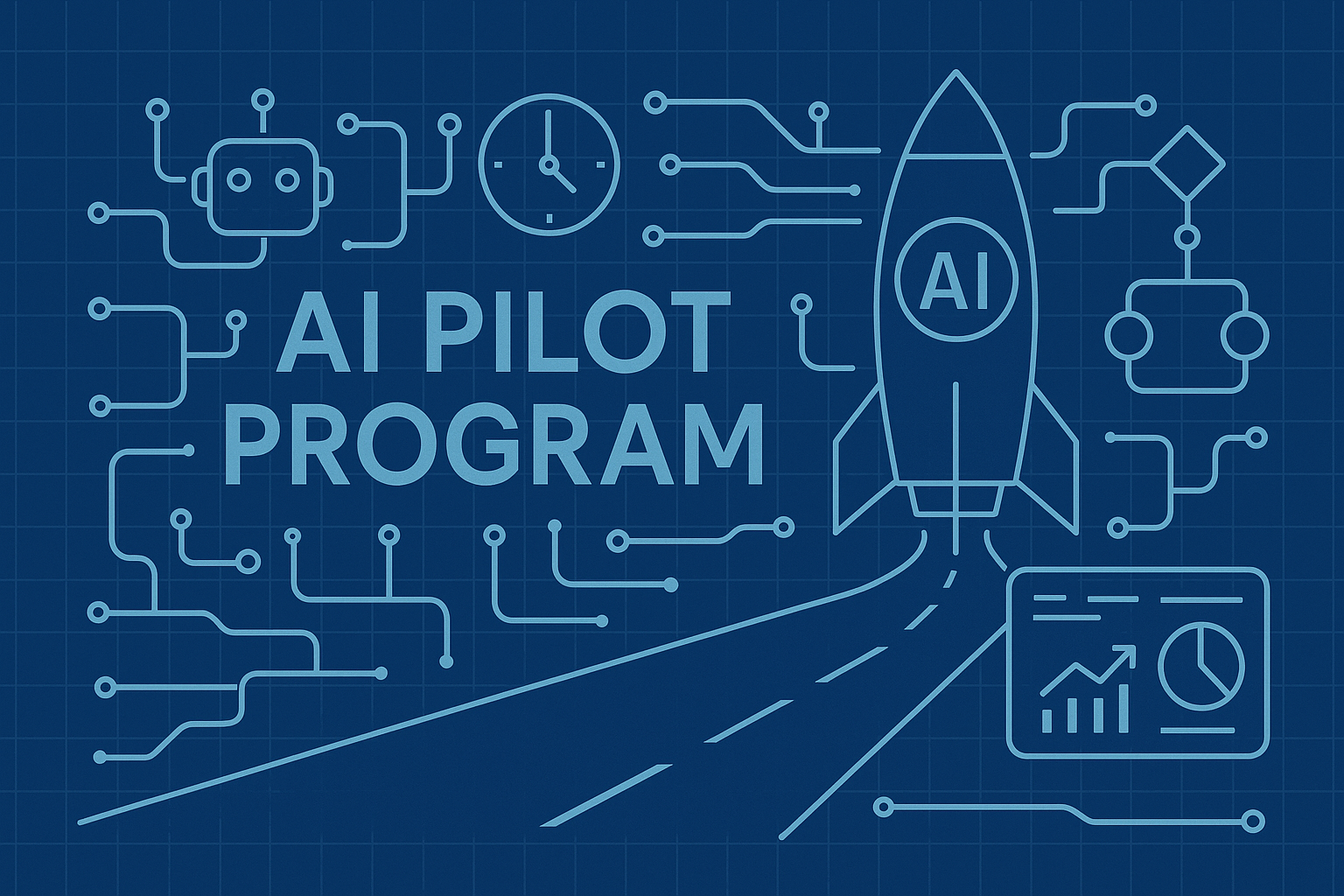
AI Pilot Program

ai pilot program

AI Pilot Program

The allure of AI is undeniable. Companies everywhere are eager to harness its power, but far too often, their AI pilot programs hit a snag. The excitement of launching a new initiative quickly fades when goals are vague, KPIs are fuzzy, and the path to proving tangible value is unclear. These stalled AI proofs of concept can lead to wasted resources, dampened enthusiasm, and missed opportunities.
You don’t want to just try AI; you want to prove its worth. For small businesses, this means selecting a single, high-value use case that can demonstrate measurable results quickly—say, within six to eight weeks. It could be cutting the time it takes to create weekly reports or significantly reducing first-response time in customer support tickets. The key is focus and clarity from day one.
Interest in “AI pilot programs” recently spiked after real-world examples like Pennsylvania’s public-sector rollout of ChatGPT Enterprise hit the news, showcasing the potential (and challenges) of real-world AI implementation. This highlights the timeliness of a strategic approach, ensuring your small business AI pilot doesn’t just run, but succeeds. As executive primers from ScottMadden and Red Hat on pilot preparation consistently emphasize, clear objectives and disciplined execution are paramount.
ai pilot program
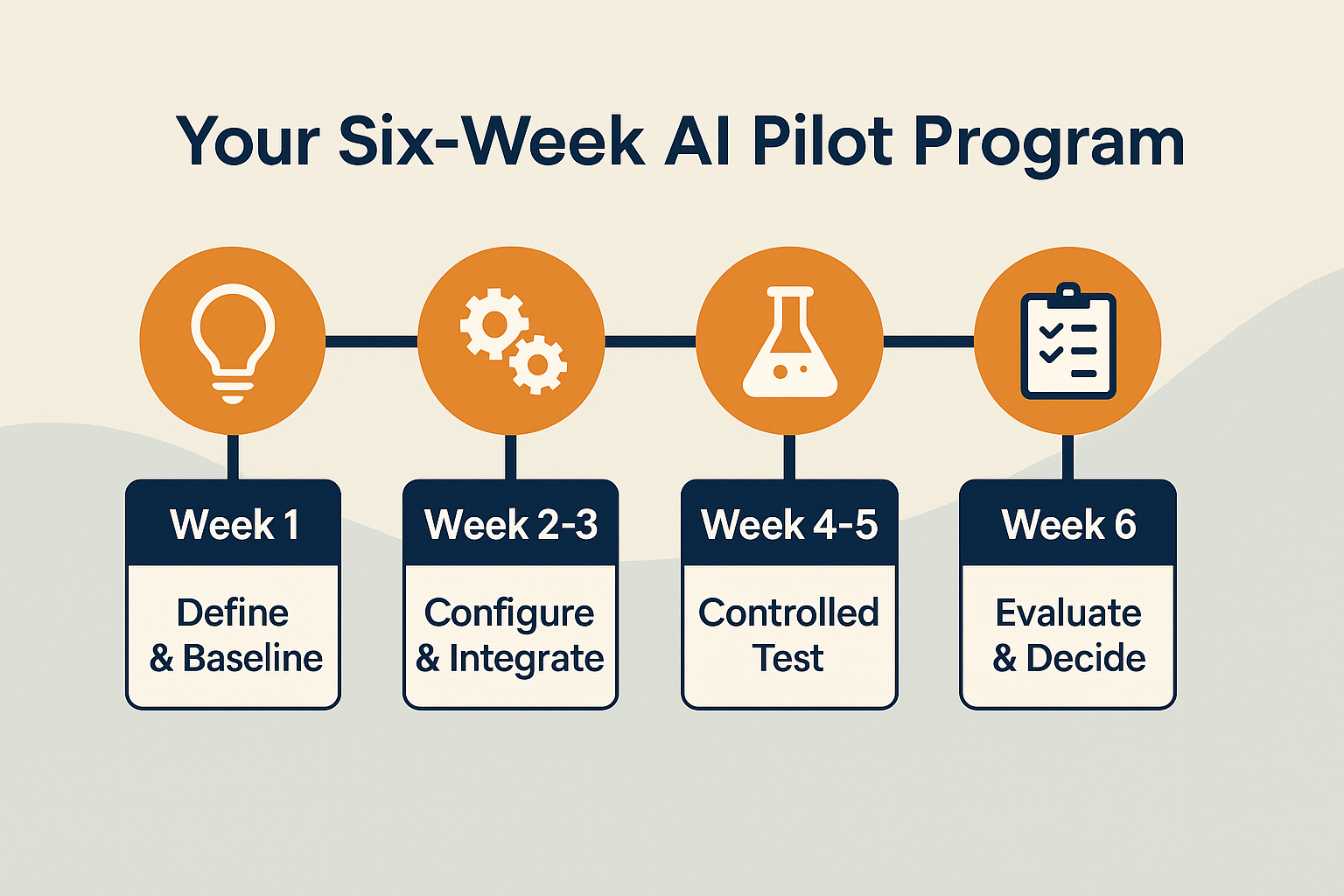
So, how do you run an AI proof of concept that delivers tangible results and builds confidence for broader adoption? Here’s a concrete six-week calendar to guide your AI pilot program.

Why an AI Pilot Program Matters for SMBs

A well‑scoped pilot provides four decisive advantages to small and mid‑sized businesses. Speed to insight comes first: six focused weeks are long enough to surface meaningful data yet short enough to safeguard the budget. Next is resource focus—by targeting a single, high‑value use case, your team avoids distraction and scope creep. The third benefit is risk mitigation; by validating the concept in a controlled environment, you gain proof before committing to an enterprise‑wide rollout. Finally, early success generates momentum. Clear wins boost stakeholder confidence and unlock the appetite for further AI investment. Pro tip: Keep the pilot narrow. One process, one set of users, and a handful of KPIs will reveal more than any sprawling wish list.

The Six-Week AI Pilot Program Roadmap

This structured approach ensures your pilot stays on track, focuses on measurable outcomes, and provides clear insights.

Week 1: Define & Baseline

Begin by picking the problem you want to solve. Focus on a repetitive, time‑consuming, or error‑prone task that frustrates the team and drains productivity. Once the use case is clear, set specific KPIs—for instance, commit to cutting weekly report‑build time by 50 percent. With goals locked, capture the before picture by measuring current cycle time, error rates, and user satisfaction. Finally, build the squad that will steer the pilot: an operational owner who owns the workflow, an IT or data lead who manages integrations, and an AI champion who configures the model and drives adoption.

Week 2-3: Configure & Integrate

With a solid baseline in hand, spend the next two weeks preparing the solution. First, configure the model—tailor prompts, fine‑tune parameters, or establish a retrieval‑augmented generation pipeline so responses stay grounded in your data. Next, connect live data securely, verifying permissions, cleansing records, and patching any quality gaps. Wrap up the phase by running smoke tests; catching integration issues now prevents user frustration later.

Week 4-5: Controlled Test & Side-by-Side Comparison

Move into a controlled test by running the AI‑enabled workflow in parallel with the legacy process. This side‑by‑side approach lets you compare apples to apples while minimizing business risk. Track KPIs daily, making progress visible through a lightweight dashboard or shared spreadsheet. Hold short ten‑minute stand‑ups so blockers surface early, and capture qualitative feedback to learn what users like, where they hesitate, and how the new approach changes their day‑to‑day work.

Week 6: Evaluate & Decide

In the final week, crunch the numbers and stack the pilot KPIs against the baseline. Then host a pilot review to share wins, gaps, and lessons learned with decision‑makers. Use the data to call the shot: give a green light if targets are met or exceeded and start planning the wider rollout; opt to iterate if the numbers are close but issues are solvable; or stop altogether if the value simply doesn’t justify the effort and redirect resources to a higher‑potential opportunity.

Common SMB Use Cases & Success Metrics

To help you choose your pilot, here are some AI pilot examples and the metrics you’d typically track:
Use Case AI Application Sample Pilot KPIs
Customer Service Draft first responses; summarize tickets Time saved per inquiry · First-response time · CSAT
Marketing Copy Brainstorm headlines; write social posts Content produced per week · Engagement rate
Financial Reporting Extract invoice data; flag anomalies Report prep time · Error rate · Accuracy score
Internal Knowledge Answer employee FAQs from docs Search time saved · Employee satisfaction
Sales Lead Qual. Score leads; draft follow-ups Lead qualification rate · Sales cycle length
Focus on one of these areas, not all of them. The tighter the scope, the clearer the signal.

Ready to Prove Your AI's Worth with Braveheart?

Navigating your first AI pilot program can feel like a complex undertaking, especially when you need to quickly demonstrate tangible results. At Braveheart, we understand that for small businesses, every investment must deliver clear value.
That’s why we partner with you to design and execute focused, KPI-driven AI proofs of concept. We’ll help you select the right high-value use case, establish clear AI pilot KPIs, and guide you through our six-week plan—from baseline capture and model configuration to controlled testing and thorough evaluation. Our experts ensure your small business AI pilot doesn’t just run; it provides clear, actionable insights that empower confident decisions about broader AI adoption.
Don’t let your AI initiatives stall. Let Braveheart help you prove the real-world value of AI in your business.

The Braveheart AI Transformation Series

AI Training for Employees

AI Training For Employees

AI Training For Employees

The AI revolution isn’t just for tech giants anymore. From drafting emails to analyzing data, AI tools are quickly becoming essential for boosting productivity across every industry. Yet, despite the clear benefits, there’s a significant disconnect: only about one-third of today’s workforce feels truly AI-ready. This gap is costly, especially when productivity studies consistently show that trained employees are the ones who unlock the vast majority of AI’s potential ROI.
You don’t need to send your entire team back to school for a computer science degree. What small businesses need is a rapid, practical approach to AI training for employees, one that quickly moves them from “AI-curious” to “AI-competent.” We’re talking about an AI enablement program designed for impact, not just information overload.
AI Training For Employees
The good news? You can achieve significant AI upskilling within a focused timeframe, like a two-week enablement sprint. Forget generic “what is AI?” slides. This approach is all about targeted, role-based learning that empowers your team to integrate AI into their daily workflow, fast. These GenAI training courses don’t just explain AI; they show your team exactly how to use it to make their jobs easier and more effective.
The market is ripe for businesses that get this right. Keywords like “AI training for employees,” “AI upskilling,” “AI enablement program,” and “LLM skills workshop” are seeing significant monthly search volume with relatively low competition among SMB blogs, highlighting the demand for practical guidance.
So, how do you execute a high-impact, two-week enablement sprint? Let’s break it down.

Week 1: Foundational Skills & Role-Based Deep Dives

Day Focus What Your Team Gains
1-2 AI Fundamentals & Responsible Use • Plain-English intro to GenAI and large-language models (LLMs) • Your customized, lightweight AI policy—privacy, ethics, and human-review checkpoints A shared vocabulary and clear guardrails so every employee can innovate safely
3-5 Role-Based Workshops Marketing: Prompt templates for campaign brainstorming, social content, and ad-copy testing Customer Service: Retrieval-augmented generation (RAG) for faster, more accurate replies IT / Dev: Secure environment setup, API-key rotation, and model fine-tuning basics Practical, copy-and-paste prompts and checklists employees can use the same day

Week 2: Hands-On Labs, Refinement & Internal Champions

The second week solidifies learning through practice and builds internal support for ongoing enablement.
Day Focus What Your Team Gains
6-8 Sandbox Labs
Employees practice in custom GPT or Gemini sandboxes seeded with anonymized company data.
Example: Marketers use a “Brand Voice GPT” to draft compliant email subject lines; Customer-Service reps query a “Product Info Gem” to resolve warranty questions.
Muscle memory and confidence in a risk-free environment
9-10 AI Champion Shadowing
Tech-savvy staff shadow trainers, learning both content and pedagogy.
An internal expert network that sustains momentum after Braveheart steps away

Measuring Success: A Simple KPI Matrix

Training is an investment, and you need to see a return. A simple KPI matrix can help you measure the impact of your enablement sprint:
  • Usage Rate – % of employees performing tasks with AI at least 3× per week.
  • Time Saved per Task – Minutes shaved off core workflows (e.g., 15‑minute reduction in complex support tickets).
  • User Satisfaction – Survey scores on perceived efficiency and confidence.
  • Quality of Output – Spot‑check AI‑generated work for brand and bias compliance.
Track these metrics at 30‑, 60‑, and 90‑day intervals to quantify ROI.

Ready to Activate Your AI Advantage?

The productivity gains of generative AI belong to companies that empower their people first. Braveheart’s two‑week AI training for employees program blends expert instruction, custom sandbox environments, and internal champion development to make that empowerment real—and measurable.
➡️ Book your free consultation to craft a bespoke GenAI course and unlock your fastest path to AI ROI.

Your competitors aren’t waiting—why should you?

The Braveheart AI Transformation Series

AI Governance Framework

AI Governance Framework

Building an AI Governance Framework That Fits a Small Business

The buzz around AI, especially generative AI, has small businesses everywhere racing to pilot new tools. From automating customer service to generating marketing copy, the potential is undeniable. Yet, in this exciting rush, many firms discover a harsh reality: compliance, bias checks, and cost controls often become painful afterthoughts. The initial excitement can quickly turn into a headache as questions about data privacy, security, and ethical use surface, grinding projects to a halt.
You’ve likely heard of AI governance frameworks, large enterprises are building out 50-page policies to manage their massive AI initiatives. But if you’re running a small to medium-sized business, that kind of heavyweight document is overkill. What you need is a practical, five-page SMB playbook that handles privacy, security, and human-in-the-loop review without becoming a bureaucratic bottleneck. This isn’t about stifling innovation; it’s about channeling it safely and effectively.

The need for clear AI governance for small businesses is more pressing than ever. Searches for “AI governance framework” have nearly doubled since January 2024, a clear sign that teams are struggling to operationalize GenAI safely. As Red Hat’s 2024–25 research on deployment pain points highlights, technical hurdles are often compounded by a lack of clear strategy and oversight.

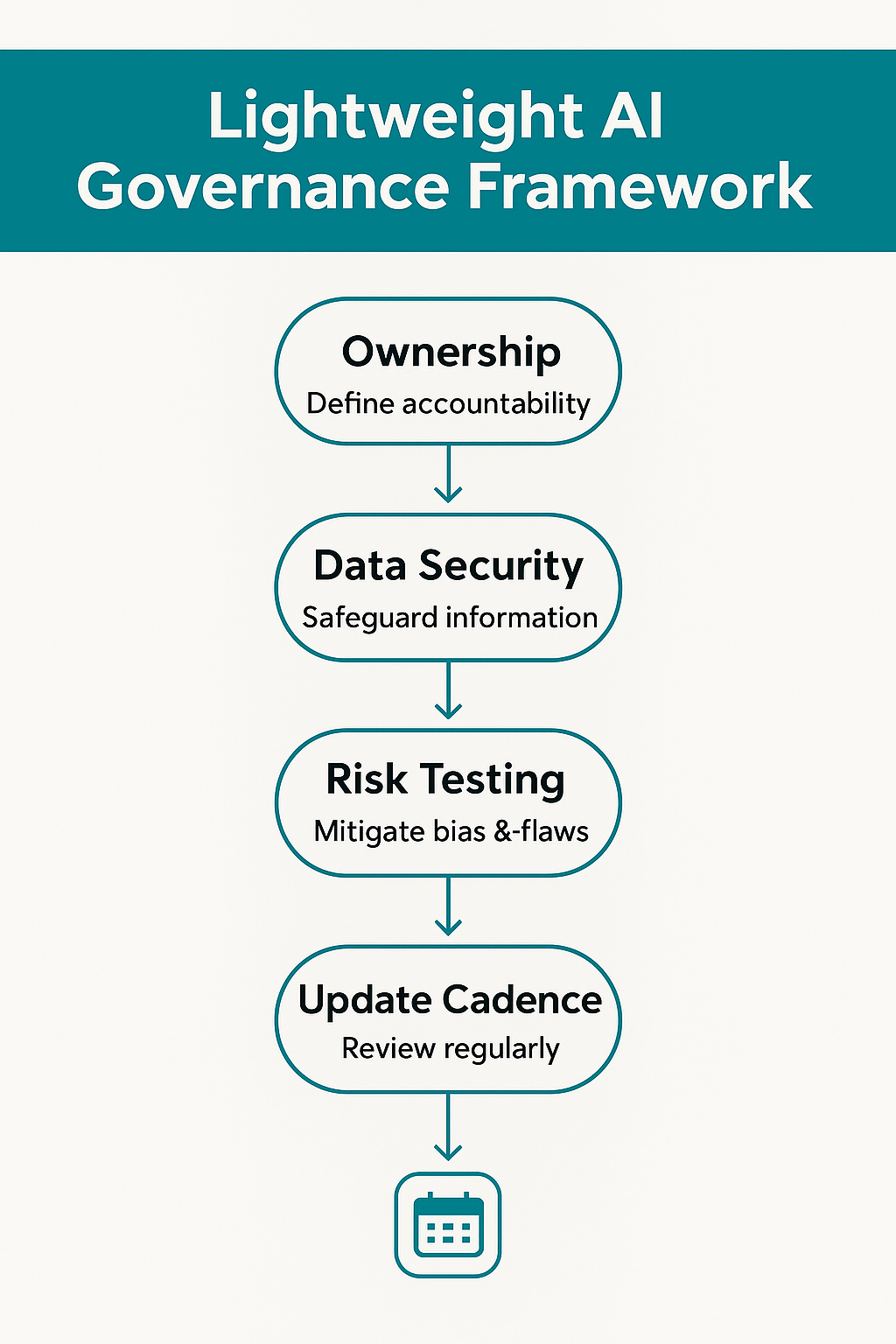
So, how do you build a lightweight AI policy that actually works for your business? Let’s walk through four essential pillars.

1. Ownership: Who's in Charge of Your AI?

In a small business, roles often blur, but with AI, clear ownership is critical. This isn’t about micromanaging every prompt; it’s about defining accountability for the overall AI strategy and its outputs.
Define Approvers:Who has the final say on the adoption of new AI tools or significant updates to existing models? This could be a single founder, a department head, or a small, cross-functional team. The key is clarity.
AI Governance Framework

Prompt Guidelines: Establish clear guidelines for how employees should interact with AI, especially when inputting sensitive data or generating public-facing content. Who approves the core “prompts” or instructions that guide your AI tools, especially for critical tasks?

Model Update Review: AI models are constantly evolving. Determine who reviews and approves these updates. Are there specific performance benchmarks or safety checks that must be met before a new model version is deployed?

Escalation Path: What happens if an AI output is questionable, biased, or even unsafe? Define a clear escalation path. Who should be notified? What’s the process for investigation and correction? This turns a potential crisis into a manageable incident.

2. Data Security: Protecting Your Information from End to End

Data is the lifeblood of AI, and its security cannot be an afterthought. This pillar focuses on safeguarding the information you feed into and receive from AI systems.

Input Data Protection: What kind of data can be fed into AI models? Establish strict rules about sensitive customer information, proprietary business data, or confidential communications. Ensure your AI tools comply with your existing data privacy regulations (like GDPR or CCPA) and internal policies.

Output Data Handling: How will AI-generated content be handled? Is it stored securely? Who has access to it? What are the retention policies?

Third-Party AI Tool Vetting: Before adopting any new AI software, conduct thorough due diligence. What are their data privacy and security policies? Where is your data stored? How is it used? A one-page privacy checklist can simplify this vetting process, ensuring you ask the right questions every time.

Access Controls: Implement strong access controls for anyone using or managing AI tools. Not everyone in your company needs access to every AI system or its underlying data.

3. Risk Testing: Spotting and Mitigating Bias and Flaws

AI models can perpetuate or even amplify existing biases found in their training data. Proactive AI risk management is crucial to prevent reputational damage, legal issues, and poor decision-making.

Bias Checks: How will you test for bias in your AI outputs? For example, if you’re using AI for hiring, how do you ensure it’s not discriminating based on gender, age, or ethnicity? Simple, repeatable tests should be documented.

Performance Monitoring: Beyond bias, how do you ensure the AI is performing as expected? Set up metrics to track accuracy, relevance, and efficiency.

Human-in-the-Loop Review: Not every AI output should go straight to a customer or into a business decision. Define when human review is mandatory. This “human-in-the-loop” approach adds a vital layer of quality control and ethical oversight. For instance, any customer-facing communication generated by AI might require human approval before being sent.

Auditing and Logging: Ensure your AI systems log their activities, inputs, and outputs. This creates an audit trail that can be invaluable for troubleshooting, compliance, and demonstrating accountability.

4. Update Cadence: Keeping Your Playbook Fresh

An AI compliance checklist or playbook isn’t a “set it and forget it” document. The AI landscape is evolving at lightning speed, and your governance framework needs to keep pace.

Quarterly Review: Schedule a regular, ideally quarterly, review of your AI governance playbook. This ensures it remains relevant and addresses new challenges or opportunities.

Feedback Loop: Encourage employees using AI tools to provide feedback on the playbook. Are there areas that are unclear? Are new risks emerging?

Stay Informed: Dedicate someone (or a small team) to staying informed about new AI regulations, best practices, and emerging risks. This doesn’t have to be a full-time job; a few hours a month can make a big difference.

Cost Tracking: Integrate a cost tracker into your AI usage. Finance needs to see usage and expenditure in near real-time. This helps control budgets and informs future AI investments.

Your One-Page AI Governance Checklist

Moving from broad guidelines to a practical playbook is about transforming compliance from a blocker into a documented, low-friction routine. By defining who approves prompts, how bias tests run, what the escalation path is, and when human review is mandatory, you create clarity and confidence. Store this playbook in your company’s existing knowledge base, your intranet, shared drive, or preferred collaboration tool, so it’s easily accessible to everyone.

To get started, download our one-page AI governance checklist. It’s designed to help small businesses quickly assess their current state and identify immediate next steps for building a robust, yet flexible, AI governance framework that scales with their ambition.

Ready to Build Your Lightweight AI Playbook with Braveheart?

Building a robust yet agile AI governance framework might seem daunting, but it doesn’t have to be. At Braveheart, we specialize in helping small businesses like yours transform the chaos of AI adoption into controlled, compliant, and cost-effective operations.

Our experts work with you to develop and implement a customized, lightweight AI policy and playbook that fits your unique needs. We guide you through defining ownership, establishing strong data security protocols, setting up practical AI risk management processes, and creating an effective update cadence. We don’t just provide theoretical advice; we deliver the actionable strategies and tools, including your personalized one-page governance checklist, to ensure your AI initiatives are both innovative and secure.

Don’t let compliance be an afterthought. Partner with Braveheart to establish an AI governance framework that empowers your team and protects your business.

Take the next step:

Download our detailed One-Page AI Governance Checklist to get started on your own.

Contact Braveheart today for a free consultation to discuss how we can help you build your tailored AI governance playbook.

The Braveheart AI Transformation Series

AI Search Visibility

AI Search Visibility

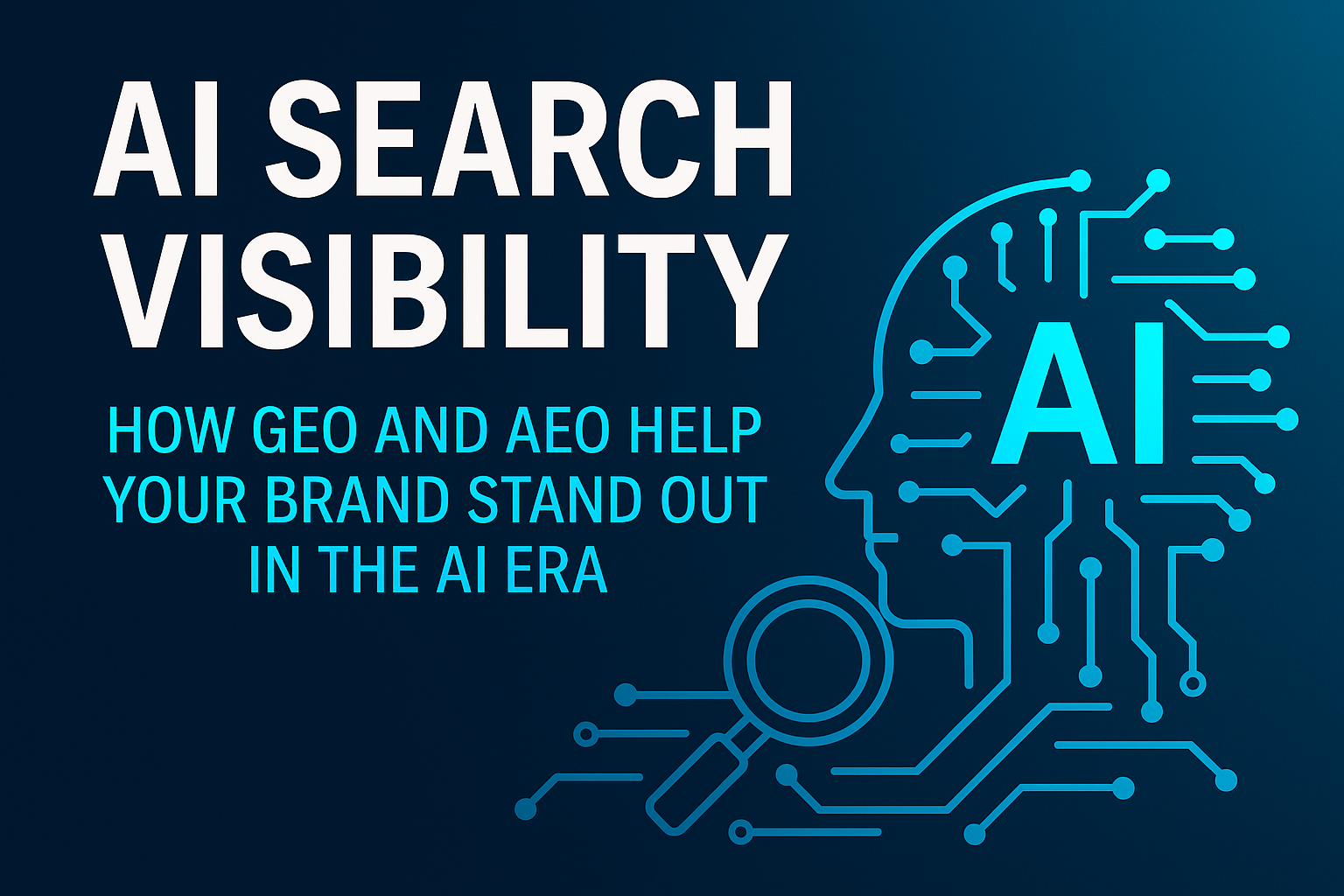
AI Search Visibility: How GEO and AEO Help Your Brand Stand Out in the AI Era

How to Keep Your Brand Visible When Chatbots and Answer Boxes Drive Discovery
As AI tools continue to redefine how users discover content, brands face a new challenge: staying visible when traditional search engine rankings are no longer the sole gatekeeper. Tools like ChatGPT, Claude, Gemini, and Google’s AI Overviews are driving a shift toward machine-curated answers—often bypassing the need for users to click through to a website.

In this new landscape, AI search visibility is about more than just ranking in search results. It’s about ensuring your content is surfaced, cited, and trusted by both generative AI models and algorithmic search features. This demands a dual focus: Generative Engine Optimization (GEO) for LLM-based tools, and Answer Engine Optimization (AEO) for featured snippets and structured search elements. Ignoring either one means missing out on traffic, leads, and ultimately, revenue.

AI Search Visibility

Understanding Generative Engine Optimization (GEO)

AEO targets visibility in structured search results—featured snippets, “People Also Ask,” and AI Overviews. These elements lift short, clear answers from webpages to display directly in search results. AEO is about formatting your content so search engines can quote it word-for-word.
Strong AEO strategy starts with content structure. Place a 40–60 word answer directly after a question-based H2 heading. Implement FAQ and How-To schema to guide search engines through your page structure. Even in zero-click scenarios—when users get their answer without visiting your site—ensure the content references your brand to drive awareness and credibility.

GEO vs. AEO: Two Paths to AI Search Visibility

GEO AEO
Primary Surfaces ChatGPT, Claude, Gemini, Perplexity Google AI Overviews, Featured Snippets, Bing Cards
Answer Format Multi-paragraph narrative answers One- to two-sentence definitions
Optimization Focus Semantic depth, topical authority, credibility Concise structure, schema markup, clear formatting
Measurement Brand mentions in chatbot responses, referral tokens Featured snippet wins, impressions vs. clicks
Key Risk Being paraphrased without attribution Zero-click exposure with no user visit

Both approaches depend on strong SEO fundamentals, but they diverge in how knowledge is delivered. GEO packages deep, multi-faceted content for comprehension by AI models. AEO structures content for precise, machine-readable answers.

Action Plan to Improve AI Search Visibility

To compete in this difficultenvironment, brands need a unified content strategy that supports both GEO and AEO. Begin by auditing your content for answerability—identify queries where you rank on page 1 but aren’t surfacing in snippets or AI responses. Rewrite those sections using a question-answer format to target both types of engines.
Cluster related questions in longer-form pillar content to build semantic strength. Embed credibility cues such as expert bylines, citations, and authoritative outbound links. Implement FAQ schema sitewide to improve AEO coverage. Finally, track performance using tools like Perplexity Analytics and AlsoAsked to monitor LLM citations and featured snippet win rates.

Real-World Success Stories

Some brands are already succeeding in AI search visibility. Zalando, for example, opens each product guide with a snippet-ready definition and a quick “Key Facts” section—ideal for AEO—followed by GEO-rich long-form content on style trends, sourcing, and sustainability.

HubSpot’s “What is CRM?” page is another standout. It dominates Google’s featured snippet while also appearing verbatim in ChatGPT answers. This is thanks to a hierarchical structure that balances clear definitions with in-depth exploration—perfectly optimized for both GEO and AEO.

Final Thoughts on Mastering AI Search Visibility

Search isn’t going away—it’s evolving. Brands that continue to write solely for crawlers will vanish from AI-generated answers. Conversely, brands chasing LLM mentions alone will miss the high-intent visibility offered by traditional SERPs.
The winners in this new era will speak both dialects. At Braveheart Digital Marketing, we specialize in helping forward-thinking companies dominate both the search engine results page and the AI-powered answer landscape. From GEO and AEO audits to AI-ready content strategies and KPI tracking, we’ll help you ensure your brand is visible—whether it’s a bot or a buyer doing the search.
Let’s future-proof your content together.

Further Reading

Recent Posts

GEO FAQs

GEO FAQ

GEO FAQs: Your Advanced Guide to Generative Engine Optimization In our previous post, Generative Engine Optimization FAQs, we explored the fundamentals of GEO and introduced

Read More »